Mayla – The AI Assistant for PLM Process Optimization
AI-Powered PLM Optimization for Faster, Smarter Product Development with ILC’s Mayla
AI tools are evolving rapidly – but which solution truly fits your company’s PLM processes?
Many organizations struggle with disconnected systems, limited integration, and untapped potential across the product development lifecycle.
Mayla, the AI assistant from ILC, is built specifically for PLM process optimization.
It integrates seamlessly into your existing environment – so you can enhance your PLM workflows without adding new system complexity.

Why Choose Mayla for Your PLM Processes:
- Boost Efficiency Across the Product Development Lifecycle
Reduce complexity and accelerate workflows from concept to release with AI-powered automation. - Seamless Integration into Your PLM Environment
Mayla works directly within your existing PLM workflows—eliminating data silos and avoiding additional tools. - Data-Driven Decision-Making
Gain full transparency and make informed decisions with AI-powered insights based on your data. - Reduce Manual Workload
Automate repetitive tasks and free up your teams to focus on high-value activities. - Accelerate Innovation
Enable agile, future-ready product development with intelligent AI support.


Experience AI-Powered PLM Optimization with Mayla
See how Mayla transforms your PLM processes in real time.
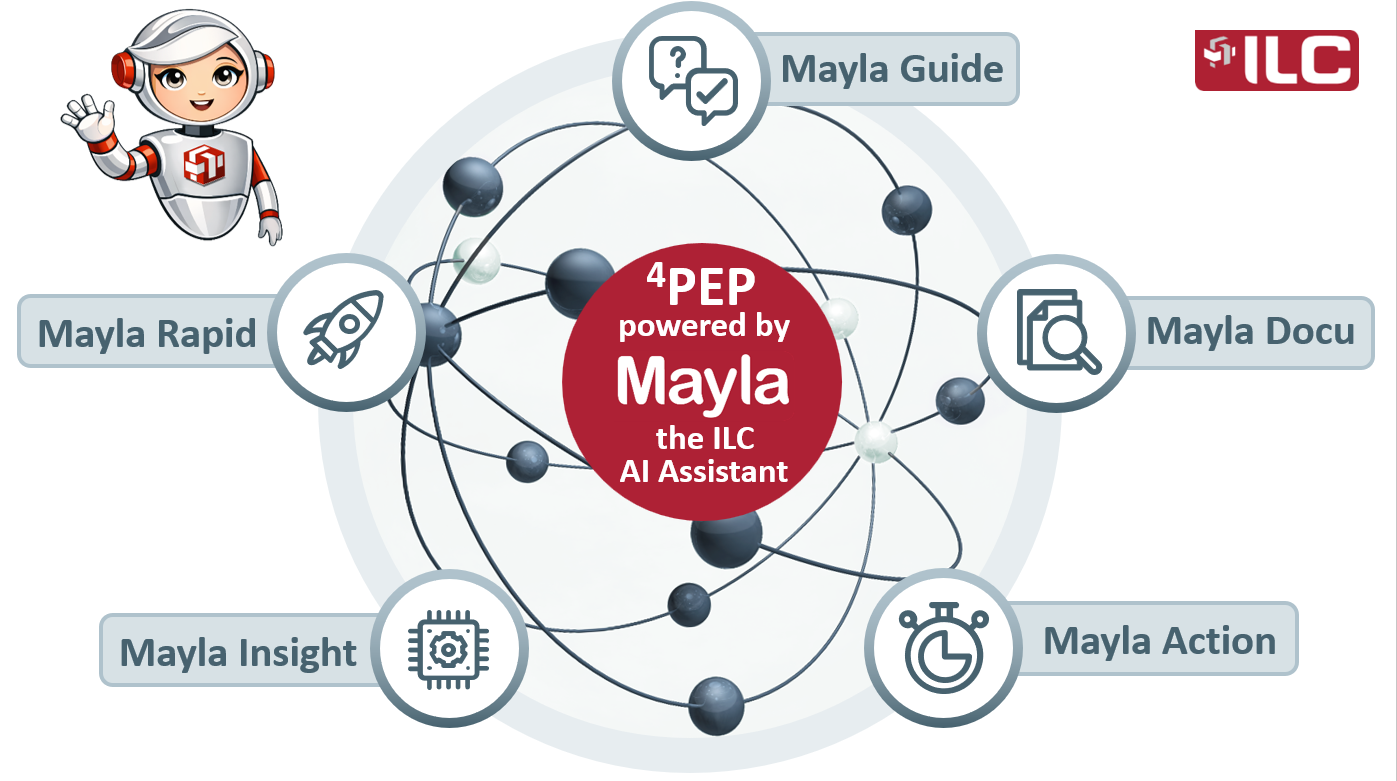
Mayla Module at a Glance
Mayla Guide – AI Support for ⁴PEP
- provides guidance for using 4PEP
- delivers up-to-date 4PEP information directly within your workflow
- answers user questions in plain language
- supports onboarding and daily usage of 4PEP for all experience levels
Mayla Docu – AI Document Management for PLM
- organizes and manages documents efficiently
- AI-powered document management with full control over large datasets
- structured search and retrieval of information
- automated document summarization and translation
- secure access control based on the need-to-know principle
Mayla Action – Execute PLM Tasks with AI
- executes actions in 4PEP
- controls system functions in 4PEP via voice or text
- reduces training effort
- speeds up execution of PLM processes
Mayla Rapid Architecture
- structures and develops product and system architectures
- provides support from the initial idea through requirements and functions to the system architecture
- identifies requirements, specifications, and other documents as a knowledge base and structures relevant information for further development
- provides users with dialogue-based guidance in developing and defining requirements, functions, and architectural concepts
- utilizes existing project knowledge and resources to reuse information and reduce duplication of effort
- assists in the structured creation and review of requirements and SRS documents
Mayla Rapid Design – Accelerated Product Structuring
- structures and designs product data
- build product structures up to 10x faster
- refine structures using intuitive voice commands
- generate structures from prompts or sketches
- acts as an AI co-designer to support innovation
- import and model existing complex LO-VC control systems
Mayla Insight – Predictive Analytics for PLM
- analyzes and recommends actions
- uses historical data for training and validation
- predicts process outcomes such as change lead times
- enables predictable and controlled product development
Start Optimizing Your PLM Processes Today
Unlock the full potential of your product development with an AI assistant built for PLM.
FAQ on Mayla
Many companies face the challenge of isolated AI solutions without deep integration during product development. Mayla is an AI assistant developed by ILC that integrates seamlessly into your existing PLM processes. Instead of introducing additional, isolated tools, teams receive intelligent support directly within their familiar PLM workflow—without any system disconnects.
Using Mayla optimizes your processes across the 5 value streams:
- VALUE STREAM 1 – IDEA TO PRODUCT ARCHITECTURE
- Requirements, specifications, functions, and system architecture.
- VALUE STREAM 2 – ARCHITECTURE TO PRODUCT DESIGN
- Product configuration, features, rules, and engineering BOM.
- VALUE STREAM 3 – PRODUCT DESIGN TO PRODUCTION DESIGN
- Plants, resources, manufacturing BOM, and production schedule.
- VALUE STREAM 4 – FROM ARCHITECTURE TO VALIDATION PLAN
- Design validation plan.
- VALUE STREAM 5 – PROTOTYPE TO ACCEPTANCE TEST
- Test specimens, requirements, test cases, test results, and acceptance test.
Mayla drives efficiency gains throughout the product development process, ensures seamless integration into workflows, provides a better basis for data-driven decision-making, automates tasks, and supports innovation opportunities.
Through unified, AI-powered product development—from the initial product idea through to manufacturing—every object is linked and traceable. This enables end-to-end traceability all the way to the digital thread.
- Mayla has a modular design to provide targeted support for various tasks in the PLM workflow.
- Mayla Guide, Mayla Docu, and Mayla Action provide targeted support with AI assistants for your daily work with 4PEP.
- Mayla Rapid Architecture supports the “Idea to Product Architecture” value stream. Requirements, specifications, documents, and ideas are gradually combined to form a structured product and system architecture.
- Mayla provides support, in particular, in the development and structuring of requirements, functions, and system architectures, as well as in the reuse of existing project knowledge.
- Mayla Rapid Design supports the “Architecture to Product Design” value stream. Based on architectures, requirements, prompts, sketches, or existing product information, product structures—including features, variants, rules, and dependencies—can be created and further developed.
- Mayla Insight analyzes historical data and helps identify correlations and trends. This makes it possible, for example, to analyze process trends and provide forecasts as an additional basis for decision-making.

