Digital Engineering – The Future of Product Development

Home > Solutions > Digital Engineering Software for SAP
Overview Digital Engineering Technology Integration Mayla

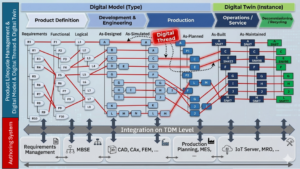
Digital Trinity – Digital Model, Digital Thread and Digital Twin

The development of modern products is becoming increasingly complex. Mechanics, electronics, software, and digital services must work together seamlessly throughout the entire product lifecycle. Traditional, document-based development processes are reaching their limits. Digital engineering lays the foundation for end-to-end, model-based, and connected product development. Systems engineering, model-based systems engineering (MBSE), the end-to-end digital thread, configuration and change management, and artificial intelligence connect information, processes, and people into a unified engineering ecosystem. This results in transparent relationships, complete traceability, and a consistent data foundation—from the initial requirement through to product operation.
Digital Engineering with ⁴PEP

Take advantage of our proven solution ⁴PEP for digital engineering!

With the Digital Engineering Platform ⁴PEP, ILC fully implements this concept in SAP S/4HANA. The platform connects the seven value streams of product development with an integrated process engine, end-to-end configuration and change management, and the AI assistant Mayla. This links requirements, system architectures, product structures, bills of materials, manufacturing information, validation data, and service information within a common information model. Existing CAD, ALM, PLM, or ERP systems remain in place as authoring systems and are intelligently interconnected via the Digital Thread. AI supports, among other things, requirements analysis, architecture modeling, impact analyses, traceability, and the automation of knowledge-intensive engineering processes.

Would you like to implement digital engineering in your company?

Benefits:

  • shorter development times,
  • fewer system breaks,
  • complete end-to-end traceability,
  • controlled change processes,
  • higher product quality and compliance, and
  • a future-proof foundation for Digital Twin, Product Memory, and agent-based AI.

This makes digital engineering the foundation of efficient, transparent, and sustainable product development.

Digital Engineering is a model-based development approach that connects people, processes, and product information throughout the entire product lifecycle. It is based on systems engineering, MBSE, the digital thread, and AI to develop complex products more quickly, transparently, and efficiently.

The Digital Model describes the product, the Digital Thread links all information and processes across the entire lifecycle, and the Digital Twin represents the real-world product in operation. ⁴PEP forms the Digital Thread and connects all relevant engineering and business objects into a unified information base.

Systems Engineering is an interdisciplinary development approach for complex products; MBSE implements this approach using formal models; and SysML is the established modeling language for this purpose. Together, they provide a consistent foundation for architecture, requirements, functions, and traceability.

Configuration Management defines the current state of a product, while Change Management oversees its controlled and traceable evolution. Together, they form the governance framework for the Digital Thread and enable complete traceability across all changes.

Value streams organize the entire product lifecycle into thematically related value streams—from the initial idea through development and validation to delivery and service. In ⁴PEP, they form the foundation of the digital thread and ensure a seamless chain of information and processes.

Project and process management coordinate teams, tasks, and engineering processes and link them directly to technical product information. The ⁴PEP Process Engine controls workflows, automates processes, and will also integrate AI agents in the future to provide intelligent process support.

Among other things, AI supports requirements analysis, architecture development, impact analyses, test case generation, and the automation of administrative engineering processes. A prerequisite for this is a structured digital thread that provides the necessary context for reliable decisions.

Product Memory extends the Digital Thread by incorporating knowledge about a product’s relationships, history, decisions, and validity. It forms the semantic foundation for agent-based AI and supports traceable and context-aware engineering decisions.

Modern products are developed across disciplines, IT systems, and lifecycle phases and can no longer be fully represented in a single PLM system. Instead, the digital thread connects the leading information sources and creates a consistent information context without unnecessary data replication.

Regardless of the business model, all product development processes are based on the same technical information, such as requirements, architectures, product structures, and bills of materials. ⁴PEP provides a common information model for this purpose and supports all scenarios with a unified digital thread.